Disclaimer: The following is for informational purposes only and not financial advice. Always do your own due diligence. I am not a licensed advisor.
Exploring the HOOY Stock ETF: A Deep Dive into YieldMax’s Latest Investment Strategy
If you’re keeping an eye on high-yield ETFs and wondering whether the HOOY stock ETF (YieldMax’s Hood Option Income Strategy ETF) is a solid investment, you’re not alone. In this article, we’ll break down what HOOY is all about, how it works, and whether it’s a smart choice for those seeking high returns. Let’s also compare it with other popular options in the market and examine its potential for consistent income generation.
What is the HOOY ETF?
The HOOY ETF was launched by YieldMax to capitalize on Robinhood’s (ticker: Hood) stock using a synthetic covered call strategy. Unlike traditional ETFs that buy and hold stocks, HOOY uses options to simulate holding Robinhood stock, generating income from the premium received by selling call and put options. This unique strategy allows investors to benefit from Robinhood’s price movements without directly owning the stock.
YieldMax’s approach to using options—especially in an ETF format—adds an extra layer of potential return through both price appreciation and options premiums. The ETF utilizes US Treasuries and FGXX mutual funds to hold cash, from which the fund sells at-the-money put options. The premiums earned from these put options are used to buy call options at the same strike and expiration, potentially generating substantial returns if Robinhood’s price moves favorably.

How Does the HOIE ETF Make Money?
HOOY generates income primarily by selling options on Robinhood’s stock. Here’s how it works in simple terms:
- Put Option Premiums: HOOY sells put options to earn premiums. These are obligations to buy Robinhood stock at a set price if the stock’s price falls below a specified strike price.
- Call Option Purchases: The ETF also buys call options at the same strike price as the put, aiming to profit from a rise in Robinhood’s stock price.
- Short-Term Calls: In addition, HOOY sells shorter-dated call options, typically one month or less, to fund monthly distributions. These calls help pay for the ETF’s 0.99% expense ratio.
What’s unique about HOOY is that it also employs a strategy called call spreads. This allows the ETF to buy an additional call option at a higher strike price. In case Robinhood’s stock surges, the extra call enables HOOY to capture more upside, while the original call position provides downside protection. This strategy makes HOOY more flexible, allowing it to benefit from high volatility, particularly if Robinhood’s stock price rises sharply.
What Makes Robinhood a Good Fit for HOOY?
Whether HOOY performs well depends heavily on Robinhood’s underlying stock, and so far, the results have been promising. Robinhood has posted impressive returns, especially when compared to other financial and crypto exchange platforms like Coinbase. Over the past year, Robinhood’s total return was an eye-popping 215.9%, far outpacing the S&P 500‘s 10.02% return and Coinbase’s -5.29%.
The strong performance of Robinhood’s stock has been a key driver for HOOY’s success, as the fund directly mirrors these movements with its options-based strategy. Additionally, Robinhood’s implied volatility (IV) is often high, with a current IV of 66.42%, which contributes to more lucrative premiums from selling options, boosting the ETF’s income potential.

Performance and Dividends: How Has HOOY Done So Far?
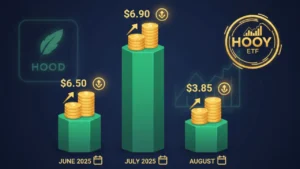
HOOY was launched in May 2025, and in just a few months, it has already shown significant promise. The ETF pays monthly dividends, which fluctuate based on the performance of its options strategy. Since launch, some of the monthly dividends have been substantial, including:
- July 2025: $6.90 per share
- June 2025: $6.50 per share
- August 2025: $3.85 per share
Given that HOOY does not pay fixed dividends like traditional dividend stocks, investors must be prepared for some fluctuations. However, the high payouts seen in the earlier months show the powerful potential of its options strategy when market conditions are favorable.
How Does HOOY Compare to Other High-Yield ETFs?
While HOOY has performed impressively, it’s not the only ETF aiming to capitalize on Robinhood’s stock price. Another key player in this space is H from Roundhill, a leveraged ETF that also uses Robinhood’s stock but with a 1.2x exposure, meaning that H magnifies Robinhood’s movements more than HOOY.
- HOOY has a total return of 40% since its launch, while H has surged by 58.23% in the same period. This difference comes down to H’s leveraged exposure to Robinhood, which means that when Robinhood’s stock rises, H rises even more. However, leverage also means higher risks. If Robinhood’s stock were to decline, H would fall more sharply than HOIE.
- H also offers weekly distributions, unlike HOOY, which pays monthly. This gives H more frequent payouts, but HOOY offers a slightly less volatile approach with its monthly income.
Should You Invest in HOOY?
Whether HOOY is a good investment depends on your risk tolerance and income goals. The ETF’s monthly income strategy is appealing to those looking for high-yield dividends, especially in the short term. However, its performance is tied to Robinhood’s price movements, meaning that the income from HOOY could fluctuate significantly based on market conditions.
If you’re comfortable with some level of risk and seeking high returns, HOOY could be a great addition to your portfolio. Keep in mind, however, that while the upside potential is high, there is no guarantee that the market conditions will always favor this strategy.

Final Thoughts
In conclusion, HOOY from YieldMax provides an exciting opportunity for income-seeking investors who want to take advantage of Robinhood’s stock volatility. By using options strategies like synthetic covered calls and call spreads, the ETF offers the chance to earn high payouts, particularly in favorable market conditions. However, it’s essential to recognize the risks involved, especially as Robinhood’s stock remains volatile.
As with any investment, do your due diligence before investing. If you’re looking for high-risk, high-reward opportunities and believe in Robinhood’s potential, HOIE could be worth considering.